

If you want to improve your performance on the bike, a good place to start is to develop an understanding of how your body works. In particular, the muscles that you use when pedalling and how other aspects of your physical form contribute to both output, comfort and injury prevention.
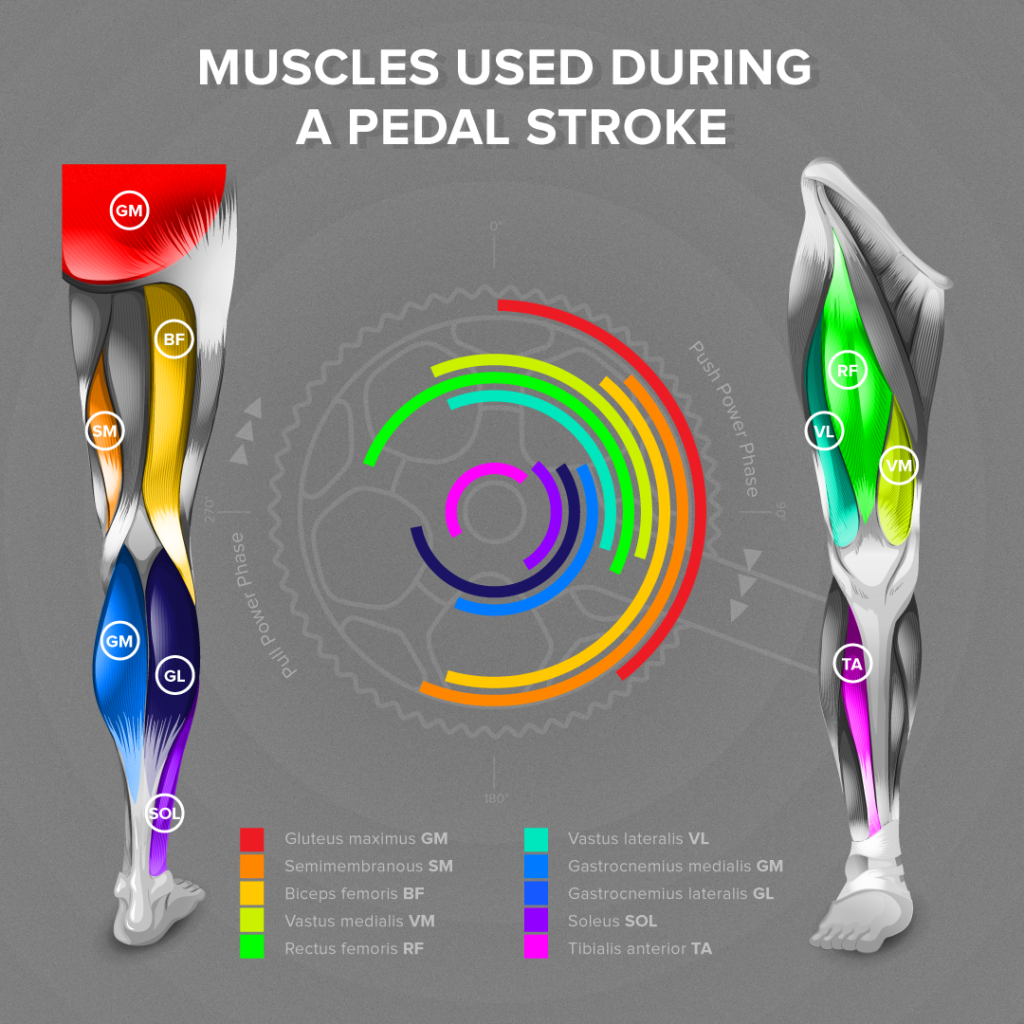
Some useful terminology:
Quads (shades of green above) – only three are highlighted in the diagram. Actually made up of four muscles in your upper leg (front). All four allow you to extend/straighten your leg. The rectus femoris is also the main muscle that can flex your hip.
Glutes – made up of three muscles in your buttocks. Gluteus maximus (red in diagram) when contracted extends your hip, increasing the angle between your stomach and your thigh.
Hamstrings (shades of orange) – only two are highlighted. Actually a group of three muscles that enable you to extend your leg straight behind your body and most importantly to bend your knee.
Calves (blue and purple) – the gastrocnemius is the larger calf muscle and has two parts. The soleus is smaller and merges with the gastrocnemius which then merges with the Achilles tendon. These muscles are responsible for plantarflexion (causing your toes to move away from your shin).
Shin muscles (pink) – the main one for dorsiflexion (pulling foot up) is the tibialis anterior.
Hip flexors – these include the iliopsoas and the rectus femoris (front quad). They enable you to lift your thigh (flex your hip) and pull your knee toward your body.
How do muscles work?
Muscles can only pull, they cannot push. They pull by contracting/shortening. A concentric muscle contraction is where the muscle is shortened as it overcomes resistance.
For example, you stand up from a chair or push down on your bike pedal by contracting some of your quads and glutes. The quads contract to extend your leg at the knee, the glutes contract to extend your hip. When standing from a chair (or a squat), the resistance is gravity and the amount of effort required depends on how heavy you are. When on your bike, the level of resistance depends on how much power is needed to turn the crank arm. This will be determined by gear selection, gravity (taking your weight into account), aerodynamic drag and rolling resistance (the force due to mechanical friction in the drive train and energy losses in the tire rubber).
An eccentric muscle contraction is where the muscle works actively to slow its lengthening against a force.
For example, when you lower yourself with control into a chair (or squat) both your quads and glutes are slowing lengthening against the force of gravity. If you relaxed these muscles you would fall to the chair. Cycling involves mainly concentric work and little or no eccentric contractions. Your quads and glutes obviously do lengthen during the pull power phase but they are not working against a force (nothing is “pushing” to bend your leg and flex your hip – the force is actually in the opposite direction).
If the goal is increasing muscle strength, eccentric contractions are more effective than concentric contractions mainly because you can apply a greater force to tensed, but relaxing muscle fibres than in the concentric phase of active muscle contractions. For example, you may be able to slowly lower your body weight onto a low bench on just one leg but can’t stand back up again unless you utlise the other leg.
In summary, when you cycle your leg muscles get plenty of practice doing concentric contractions. Hence any work you do off the bike should focus on eccentric contractions. Sample exercises (demonstrated on the Zoom session) are:
- Goblet squats – work to keep torso upright as you lower slowly (use chair if needed)
- Bulgarian single leg squats – lower slowly (option to have lifted leg lightly resting on chair behind you). Use both legs to get back up if needed.
- Pulsing lunges – lower slowly (and raise back leg to increase intensity). Keep torso upright.
- Glute bridges controlling the descent – double leg and then single leg (can raise feet/foot on chair). Ensure your glutes are firing otherwise your hamstrings will take over.
- Slow single leg heel drops on a step.
What other muscles should you look to strengthen?
Cyclists who cannot hold a position with little or no movement of the pelvis during pedalling and who cannot maintain a neutral spine (flat lower back), are easily identifiable as they will exhibit excessive side to side movement. This is particularly evident when climbing or when driving hard on the down stroke. The inability to hold this position is not only inefficient (due to power leakages) but it leaves the cyclist susceptible to overuse injuries caused by altered alignment of the hips and the knees.
Hence a strong core is a fundamental necessity for effective cycling. In particular, we want to work on those core muscles that control rotation (twisting) and rocking (where the gap between your hips and ribs widens or shortens). Sample exercises (demonstrated on the Zoom session) are:
- Mountain climber in front plank on hands (bring knee to elbow) – progress to spiderman press ups.
- Side plank on elbow – progress to adding rotation (plus option to hold weight).
- Shoulder tap in front plank on hands. The key is to keep your torso and legs static whilst lifting your hand to the opposite shoulder – progress to renegade row with weights (can alternate arms or do just one and then do the other arm for the next set)
- Back extensions lying on your front – I, Y, T W arm positions. Keep legs and buttocks relaxed.
- Deadlifts with hand weights – start standing on both legs and then progress to single leg. Keep back straight throughout. Keep knees soft but don’t bend knees as you slide the weight down the front of your leg.
I hope readers find this article useful. Please get in touch if you want more guidance. Next we will focus on flexibility.

Leave a Reply